THE APOTHECARY
The sanctuary
Discover the origins of Gravebloom, its peculiar inhabitants, hidden chambers, and the doorway concealed beyond its shelves.
ENTER THE APOTHECARY
Home
Lore
The Seven
Gallery

TOS
Commissions
Portfolio
Credits

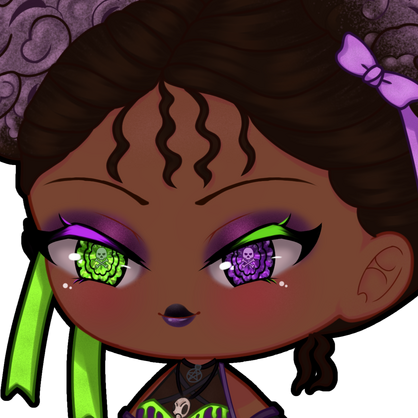
⚗ THE SEVEN
Meet the Mavens who tend these halls.
☾ THE ARCHIVES
Gravebloom, Faerwood, its creatures and its stories.
❦ THE GREENHOUSE
Artwork from the Apothecary and beyond.
⚗ THE COMMISSION COUNTER
Art, tarot, adoptables and available services.
♛ THE PORTFOLIO
Selected finished work and creator projects.
⚖ THE FINE PRINT
Commission terms, permissions and usage.
❦ ───── ⚗ ───── ❦
⚗ ♜ ⚡ ✦ ☀ ♛ ☾
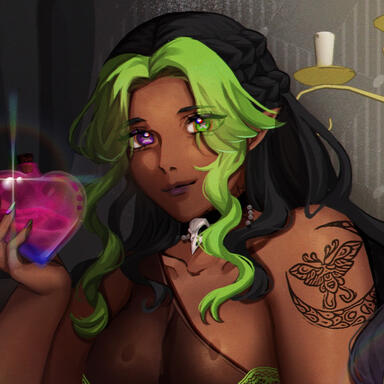
Pronouns: She / They
Species: Vampiric Fae (Vairy)
Role: Guardian in the Forest
Personality: Alluring, enigmatic, protective.
The brightest light in the forest is often the most poisonous.
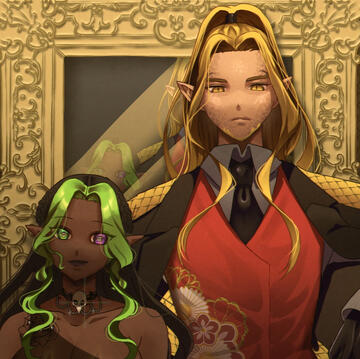
Elpis is the alluring presence who guides wandering visitors toward the Gravebloom Apothecary. Beneath her inviting charm lies an ancient and dangerous nature, though those she welcomes may find an unexpected sanctuary within her walls.

Pronouns: She / They
Role: Guardian of Hartstall Sea
Personality: Imaginative, enigmatic, observant.
Not everything you find in the dark is awake.
Dreamscape exists where imagination and reality begin to blur. A writer and keeper of stories, she moves through dreams and shifting worlds, where even the familiar can become something extraordinary. Her presence brings a quieter kind of mystery to the Gravebloom Apothecary.

Role: The Omen of the Seven Mavens
Personality: Mischievous, unpredictable, spirited.
Bad luck rarely knocks before entering.
Jinx is the unpredictable spark wandering through the Gravebloom Apothecary. Where others find order, she finds opportunities for mischief, turning ordinary moments into unexpected adventures. Whether her arrival brings good fortune or trouble is something visitors must discover for themselves.
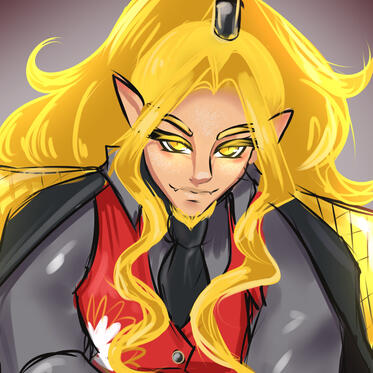
Pronouns: He / Him
Species: Dragon
Role: Warden of Hartstall Sea
Personality: Commanding, protective, calculating.
Every sanctuary needs someone guarding its doors.
Dragomir is the imposing Warden whose presence commands respect. Beyond the Apothecary, he oversees the Umbral Concord and protects the territories entrusted to him.

Pronouns: She / They
Role: Host of the Seven Mavens
Personality: Resilient, independent, creative.
Some crowns grow from the wounds left behind.
Maven is the host at the heart of the Seven Mavens, a creator whose world is shaped by art, stories, and the determination to keep growing. She represents the crown not as something inherited, but as something reclaimed, a symbol of survival and the strength to build a sanctuary from what remains.

Pronouns: He / Him
Species: Unknown
Role: Underboss of the Umbral Concord
Personality: Reserved, formidable, fiercely independent.
Some things are more dangerous when you cannot see them.
Nicali is a formidable presence who moves through the spaces others scarcely notice. Known as the Veiled One, his command of liminal spaces makes him an elusive and dangerous figure. As an underboss of the Umbral Concord, he operates with an authority entirely his own, revealing little to those who have not earned his trust.

Pronouns: He / Him
Species: Sun Elf
Role: Scribe, Librarian & General of Faerwood
Personality: Thoughtful, observant, loyal.
Even forgotten knowledge remembers the light.
Leoven is a keeper of knowledge and a trusted presence within Faerwood. A scholar as well as a general, he preserves the histories others have forgotten while standing beside those entrusted with protecting the realm. Beneath his composed exterior lies a steadfast determination to safeguard both the people and stories he holds dear.
☾ ───── ❦ ───── ☾
❦
The sanctuary
Discover the origins of Gravebloom, its peculiar inhabitants, hidden chambers, and the doorway concealed beyond its shelves.
ENTER THE APOTHECARYThe realm beyond
Step into a realm of ancient magic, dangerous beauty, shifting paths, and stories waiting to be uncovered.
EXPLORE FAERWOODPlaces & factions
Explore the landmarks, mysterious territories, powerful factions, and forgotten histories of the fictional Gravebloom universe.
OPEN THE INDEXCreatures & companions
Meet the curious mascots, strange familiars, enchanted creatures, and other inhabitants of Gravebloom and Faerwood.
VIEW THE BESTIARY❦ ───── ⚗ ───── ❦
“Every beginning is a lie told by someone who survived the ending.”
No two records agree on when the Gravebloom Apothecary first appeared.
Some claim it was built by a solitary poison-maker who wandered the forests carrying seven seeds and a crown of thorns. Where the seeds were planted, black roots took hold. By morning, a building stood among them, its windows glowing an unnatural green and violet.
Others insist the Apothecary was never built at all.
According to older accounts, it grew from the remains of a forgotten sanctuary, its foundations woven from roots that fed upon abandoned promises. Its doors appeared only to those who had nowhere else to turn, and its shelves filled themselves with remedies for ailments no physician could name.
A third account speaks of seven wanderers who arrived separately beneath a dying moon.
One carried poison. Another, a blade. One brought dreams, another a broken crown. The remaining three carried a shadow, an omen, and a fragment of sunlight.
They did not build the Apothecary.
They simply opened its doors.
The most troubling account, however, comes from a ledger found beneath the floorboards.
Its pages describe the Apothecary in remarkable detail, including rooms that have yet to be discovered and visitors who have not yet arrived.
The final entry bears no date. Only seven signatures.
None of the Seven Mavens acknowledge writing them. And yet, each signature is unmistakably their own.
Today, the Apothecary stands where the forest permits it, offering shelter to those who follow the green and purple light.
Whether it was planted, inherited, summoned, or remembered into existence remains unanswered.
Perhaps the truth is buried beneath its foundations. Perhaps the building itself has forgotten.
Or perhaps Gravebloom has never had a beginning at all.
Archivist's Note: Attempts to establish a definitive founding date have resulted in seven conflicting answers. The ledger has since been locked away.
ARCHIVE STATUS: ORIGIN UNVERIFIED
“The brightest light in the forest is often the most poisonous.”
There are many ways to become lost in the forests surrounding Gravebloom.
Some wander too far from familiar paths. Others follow voices that sound suspiciously like their own. A few simply turn around and discover that the road behind them has vanished.
But those who eventually reach the Apothecary often recall the same peculiar detail.
A light.
Sometimes green, sometimes violet, and occasionally both, dancing between the trees like something alive.
The oldest records warn travelers never to follow unfamiliar lights through the forest. They speak of wandering spirits, hungry things wearing beautiful faces, and paths that lead somewhere no living creature should tread.
Yet the lights surrounding Gravebloom seem different.
They never demand to be followed.
They simply wait.
Those who pursue them may encounter a woman standing beneath the twisted branches, her dark skin illuminated by an unnatural green glow. Poisonous blossoms gather where she walks, and her mismatched eyes hold the quiet amusement of someone who already knows how the conversation will end.
Elpis Hellebore.
The Lure.
Guardian in the Forest.
Some describe her as a gracious guide who offers lost travelers a path toward safety. Others remember a dangerous smile, a warning spoken too softly, or the unmistakable feeling that they were being studied.
Elpis rarely corrects either account.
She knows that the forest is not kind to everyone who enters it. Not every beautiful thing is harmless, and not every frightening creature intends to hurt you.
When asked why she leads strangers toward the Apothecary, her answers change.
Sometimes she claims the forest sent them.
Sometimes she insists they found their own way.
And occasionally, with a smile that reveals just a little too much, she asks whether they are certain they were ever lost.
No surviving record explains who first lit the green and purple path.
Some believe Elpis created it.
Others suspect the Apothecary calls to those it wishes to shelter, and Elpis merely answers.
The Guardian has never confirmed either theory.
But one detail remains consistent across every testimony.
Once the lights appear, the forest grows strangely quiet.
And somewhere beyond the trees, a door is already waiting to be opened.
Archivist's Note: Visitors are advised not to touch unfamiliar flowers, accept unmarked tinctures, or mistake the Guardian's hospitality for an absence of danger.
ARCHIVE STATUS: INVITATION ACTIVE
“Seven names upon the ledger. Seven shadows beneath the door. Not one remembers arriving first.”
The Gravebloom Apothecary has always had seven places at its table.
Whether those places were carved for the Mavens or the Mavens were drawn to fill them remains a subject of considerable disagreement.
The oldest surviving inventory lists seven possessions: a vial of poison, a weathered rook, a veil of shadows, a fractured omen, a fragment of sunlight, a broken crown, and a book of unfinished dreams.
No record explains who left them there. Yet each belongs, unmistakably, to one of the Seven.
Elpis Hellebore, The Lure, tends the poisonous gardens and guides wandering souls toward the sanctuary. Her invitation is rarely simple, but those she welcomes often discover that danger and kindness can share the same face.
Dragomir, The Warden, stands between the Apothecary and whatever might threaten it. His authority reaches far beyond its walls, though the doors of Gravebloom remain among the few he considers worth guarding personally.
Nicali, The Shadow, moves through the spaces others overlook. An underboss of the Umbral Concord, he knows that some dangers are best addressed long before they reach the sanctuary's doorstep.
Jinx, The Omen, is a reminder that no sanctuary can remain entirely predictable. Strange coincidences follow in her wake, and whether they amount to good fortune or catastrophe depends largely on whom one asks.
Leoven, The Sun, preserves histories that might otherwise vanish. A scribe, librarian, and general, he knows that knowledge can illuminate a path just as easily as it can reveal something best left buried.
Maven, The Crown, represents the sanctuary's stubborn refusal to disappear. Where others see ruin, she sees the possibility of rebuilding. Her crown is not a symbol of unquestioned rule, but of something reclaimed.
Dreamscape, The Dream, tends the stories that linger between waking and sleep. In her presence, memories become uncertain, familiar corridors change shape, and forgotten possibilities sometimes find their way home.
Together, they are called the Seven Keepers.
Not because they agree.
Not because they always walk the same path.
But because, despite their differences, the Apothecary remains.
Some visitors believe the Seven protect Gravebloom. Others believe Gravebloom protects the Seven.
The ledger offers no clarification.
On its final page, beneath seven names written in seven different hands, a single sentence appears:
“A sanctuary is not made by those who enter first, but by those who choose to remain.”
Archivist's Note: Attempts to determine which Maven holds ultimate authority have produced contradictory answers and one mysteriously scorched questionnaire.
ARCHIVE STATUS: SEVEN SIGNATURES VERIFIED
“Not every door is meant to be seen. Not every passage wishes to be crossed.”
There is a wall somewhere within the Gravebloom Apothecary that does not appear on any floor plan.
Most visitors pass it without a second glance.
Shelves of peculiar tinctures, dried botanicals, and dusty glass jars conceal its surface. Nothing about it suggests that another world waits beyond the stone.
Yet those who linger sometimes notice peculiar things.
A breeze where no window stands open.
The distant sound of water beneath the floorboards.
The scent of rain-soaked earth drifting between bottles that have remained sealed for centuries.
And occasionally, the unmistakable feeling that something on the other side is listening.
No two accounts agree on how the passage opens.
Some insist a particular bottle must be moved. Others describe a sequence of symbols carved into the wood, visible only beneath violet light.
One visitor claimed the wall simply stepped aside when Elpis approached.
Another swore it opened after Dragomir spoke a single word.
Neither account has been verified.
What is known is that the passage leads into Faerwood, a realm where ancient magic still shapes the land and the boundaries between worlds are considerably less reliable than most travelers would prefer.
The Seven Mavens cross this threshold for reasons of their own.
Elpis knows the forest paths that greet those who emerge.
Dragomir understands the dangers that wait beyond the sanctuary.
Nicali has been known to disappear into the shadows near the passage, only to return from a direction no corridor should permit.
Leoven maintains records of crossings, although several pages have been found written in languages no one remembers teaching him.
Dreamscape claims that the passage sometimes appears in dreams before it opens in waking life.
Jinx insists that the wall occasionally opens by accident.
Maven has never found that explanation particularly reassuring.
The strangest detail concerns those who attempt to return.
Most travelers emerge into the same Apothecary they left.
Others report unfamiliar shelves, different arrangements of rooms, or clocks displaying hours that have not yet occurred.
A handful insist they were gone for only moments, despite the days recorded in the ledger.
For this reason, the passage is not considered an ordinary doorway.
It is a threshold.
And thresholds, as every competent keeper knows, must be treated with respect.
Archivist's Note: Travelers are advised to remain with an authorized guide. The Apothecary accepts no responsibility for misplaced hours, altered memories, or belongings recovered before their owners have lost them.
ARCHIVE STATUS: PASSAGE ACTIVE | DESTINATION: FAERWOOD
“A sanctuary without boundaries is merely another place waiting to be ruined.”
There is no official rulebook for the Gravebloom Apothecary.
At least, none that remains the same for very long.
Visitors occasionally discover lists tucked between books, etched beneath countertops, or written in the condensation gathering on forgotten bottles.
The handwriting changes. The instructions do not always agree.
Yet certain warnings appear often enough that the archivists have begun treating them as law.
I. THE INVITATION MUST BE RESPECTED.
Those who follow the green and purple light are welcome to seek refuge. Those who attempt to force their way inside may discover that the Apothecary has considerably fewer doors than they remember.
Elpis insists this is a matter of hospitality.
The forest has offered no comment.
II. DO NOT MISTAKE SANCTUARY FOR SURRENDER.
Gravebloom offers shelter, not ownership.
No visitor may claim another's name, demand their secrets, or insist upon an explanation for why they sought refuge.
The Seven have been known to disagree on many things. On this matter, they do not.
III. NOTHING LEAVES THE SHELVES WITHOUT PERMISSION.
Every tincture, flower, relic, and seemingly ordinary object has a purpose.
Some heal. Some harm. Others simply refuse to be understood.
Unmarked bottles are not invitations to experiment.
Visitors who ignore this warning may find their reflections behaving independently for several days.
IV. THE WARDEN'S WARNING IS NOT A NEGOTIATION.
When Dragomir orders a door closed, it remains closed.
When Nicali advises someone to leave a corridor, the archivists strongly recommend doing so without requesting a demonstration.
The Umbral Concord is rarely mentioned within the Apothecary's walls.
That does not mean its reach ends at the threshold.
V. RESPECT THE THINGS THAT CANNOT SPEAK.
The poisonous gardens, the creatures beneath the floorboards, and the strange companions wandering the halls are inhabitants, not decorations.
Do not disturb sleeping familiars.
Do not harvest flowers without permission.
And should something with too many eyes begin following you, inform a Keeper before attempting to feed it.
VI. NOT EVERY STORY BELONGS TO THE LISTENER.
Leoven's archives contain histories that may be read, histories that must be earned, and histories that will never be opened to strangers.
Dreamscape's unfinished manuscripts are subject to similar restrictions.
Some knowledge is dangerous.
Other knowledge is simply not yours to possess.
VII. THE SEVENTH RULE IS NEVER WRITTEN THE SAME WAY TWICE.
One account warns visitors against following laughter into empty rooms.
Another instructs them never to answer a voice calling from beneath the stairs.
A third contains only a drawing of a broken crown.
Maven maintains that the seventh rule is quite simple.
“Remember why you were welcomed.”
Jinx claims there used to be an eighth.
No one has found it.
Despite their unsettling reputation, these customs serve a purpose.
The Apothecary is not a prison, a kingdom to be conquered, or a place where cruelty is permitted simply because its inhabitants possess the power to inflict it.
It is a sanctuary.
Those who respect its boundaries may find warmth among the shadows, companionship beneath the poisonous blooms, and a place at a table that never seems entirely full.
Those who violate them may find the forest waiting outside.
And the forest is considerably less forgiving.
Archivist's Note: The Seven Mavens have declined to approve a standardized edition of these rules. Several copies have been found with corrections written before the original text was completed.
ARCHIVE STATUS: BOUNDARIES ENFORCED
❦ ───── ☾ ───── ❦
❦ ───── ☾ ───── ❦
“Kingdoms may fall. Names may vanish. But the land remembers every footstep.”
No surviving chronicle records the birth of Faerwood.
Some scholars claim the realm existed long before the first kingdoms raised their banners. Others believe it emerged from the ruins of something older, a world whose name has been lost even to those who once called it home.
The oldest accounts speak of a forest without borders.
Its roots reached beneath mountains, its branches obscured unfamiliar stars, and its rivers carried whispers from places that had not yet been discovered.
Then came the first inhabitants.
Some arrived through passages between worlds. Others emerged from the wilderness itself. A few claimed they had always been there, though no two could agree upon what always meant.
Settlements became cities. Cities became kingdoms. Borders were drawn across valleys, coastlines, and ancient woodland.
But the land did not recognize every boundary its inhabitants created.
Forests reclaimed abandoned roads. Ruins surfaced where villages had stood only days before. Travelers discovered monuments bearing inscriptions in languages that would not be spoken for centuries.
And beneath it all, the magic endured.
Faerwood's oldest inhabitants believe the realm possesses a memory of its own.
Not a memory kept in books or monuments, but something woven into the earth, the waters, and the roots of its ancient trees.
Some places remember kindness.
Others remember bloodshed.
And there are regions where the land has never forgiven what was done upon it.
The Guardians and Wardens are said to understand fragments of this living history. Yet even they cannot command every secret the realm conceals.
Among the surviving chronicles, one passage appears repeatedly:
“We did not inherit this world. We arrived while it was dreaming.”
No author has ever been identified.
No date accompanies the inscription.
And every attempt to trace its origin has led to a different location.
Perhaps Faerwood was created.
Perhaps it was discovered.
Or perhaps it has been waiting all along for someone to remember its true name.
Archivist's Note: Historical records predating the earliest known settlements remain incomplete. Several recovered maps depict territories that have never existed, or have yet to be discovered.
ARCHIVE STATUS: ORIGIN UNKNOWN | REALM ACTIVE
“Magic does not belong to those who wield it. It merely allows them to borrow what was never theirs.”
In Faerwood, magic is not a gift reserved for the powerful.
It exists in the roots beneath ancient forests, the currents of distant seas, the stones of abandoned kingdoms, and the air that settles over forgotten battlefields.
It is older than the borders drawn upon the realm.
Older, perhaps, than the beings who first attempted to give it a name.
Scholars have spent centuries attempting to classify its origins. Some believe all magic flows from a single ancient source. Others insist the realm is sustained by countless forces, each answering to its own nature.
Neither theory has been proven.
What is known is that magic rarely behaves the same way twice.
Within the forests, it may manifest through living roots, poisonous blossoms, shifting pathways, and creatures whose forms defy ordinary understanding.
Along the seas, it moves through tides and storms, carrying voices from beneath the waves and memories from shores long since swallowed.
In the ruins of forgotten kingdoms, magic lingers in stone and metal, preserving echoes of those who once ruled there.
And in certain places, it appears to respond to dreams, emotions, promises, and names.
Yet power alone does not guarantee mastery.
A sorcerer may command fire and still find themselves unable to extinguish a single enchanted candle.
A guardian may protect an entire woodland and remain powerless to prevent one ancient tree from dying.
Even the oldest inhabitants of Faerwood acknowledge that some forces cannot be conquered.
They can only be understood, respected, or endured.
The Seven Mavens are no exception.
Their abilities are as varied as their histories, and their relationships with the realm's magic are not always peaceful.
Some shape it.
Some protect it.
Others have learned to survive what happens when it refuses to obey.
The oldest surviving teachings offer a simple warning:
“The realm lends its power freely to no one. Every gift leaves something behind.”
Whether this refers to sacrifice, consequence, or an obligation yet to be fulfilled remains uncertain.
There are those who believe magic remembers every hand that has ever touched it.
And if that belief is true, then somewhere beneath Faerwood's roots and waters lies a history far greater than anything preserved in its libraries.
Archivist's Note: Attempts to measure the realm's magical activity have produced inconsistent results. Instruments brought through the Apothecary's passage frequently cease functioning, while certain enchanted objects become unusually active.
ARCHIVE STATUS: MAGIC CLASSIFICATION INCOMPLETE
❦ ───── ☾ ───── ❦
Some atmospheric and supplemental reference images used on this character page were sourced through Pinterest and other visual-reference searches. Because AI-generated imagery is not always clearly labeled, some images may be AI-generated without that being apparent when they were originally saved.
I do not claim ownership of these supplemental images. Commissioned artwork, character art, reference sheets, and other credited pieces remain the work of their respective human artists.
Alluring, enigmatic, protective, observant, playful, and far more dangerous than her hospitality initially suggests.
There is a part of the forest surrounding Gravebloom where the paths stop behaving.
Trees lean closer together. Moss spreads across stones that were bare only moments before. Violet and toxic-green light flickers between the branches, always far enough away to make following it feel like a choice.
Those who do sometimes find a woman standing among flowers that should not exist.
Her name is Elpis Hellebore.
Brown skin catches the unnatural forest glow. Green markings brighten against it. Her mismatched eyes, one green and one purple, study strangers with the quiet amusement of someone who already knows whether they are truly lost.
Some travelers claim Elpis guided them safely from the forest.
Others insist she led them deeper.
Both accounts may be true.
Elpis has never considered temptation and guidance opposites.
Elpis has always understood what others fear about poisonous things.
Belladonna. Hellebore. Hemlock. Fungi glowing beneath dying trees. Flowers whose names have disappeared from every surviving field guide.
She tends them with care bordering on affection.
To Elpis, poison is not evil.
A plant is not wicked because someone touched what they did not understand.
The difference between medicine and poison can be preparation, knowledge, dosage, or intent.
That philosophy sits at the center of nearly everything she does.
Life and death are not opposites in a forest.
They feed one another.
The Gravebloom Apothecary contains remedies for ailments no ordinary physician has encountered, tinctures created from impossible plants, preserved specimens from across Faerwood, and several bottles the Archivist has been specifically instructed never to open.
A considerable number belong to Elpis.
Her craft combines toxicology, alchemy, supernatural herbology, and divination.
She studies what harms a creature with the same seriousness she gives to what heals it.
Perhaps greater seriousness.
Visitors often come to Gravebloom asking Elpis for a cure.
Some leave with one.
Others leave with something she describes only as an answer.
The two are not always the same.
ARCHIVIST: Do you consider yourself a healer?
ELPIS: Sometimes.
ARCHIVIST: And the rest of the time?
ELPIS: Sometimes people don't need healing.
ARCHIVIST: What do they need?
ELPIS: You ask very dangerous questions for someone sitting beside my poison cabinet.
Most visitors do not simply stumble across Gravebloom.
They see the lights first.
Green.
Purple.
Sometimes both.
They drift through the forest without demanding to be followed.
They simply wait.
Elpis is often found somewhere along the path.
Whether she creates the lights, follows them, or merely knows where they will lead remains uncertain.
Her explanations change.
Sometimes she says the forest chose the traveler.
Sometimes she insists the traveler found Gravebloom alone.
Sometimes she smiles and asks:
Elpis's beauty has caused more than one visitor to mistake her for harmless.
The mistake rarely lasts.
She can be affectionate, playful, flirtatious, curious, generous, and surprisingly gentle with those who enter Gravebloom in good faith.
Threaten the sanctuary, however, and something older becomes visible beneath that warmth.
The forest reacts to her anger.
Flowers open when they should remain closed.
Roots shift beneath the soil.
The air becomes sweet enough to make breathing feel dangerous.
Kindness is not helplessness.
Beauty is not surrender.
Elpis embodies both lessons remarkably well.
Elpis's abilities resist neat classification.
She can manipulate poisonous flora, cultivate supernatural plants, create remedies and toxins, and summon luminous spores or strange mists.
Moonlight behaves differently around her.
Sometimes it illuminates.
Sometimes it conceals.
Sometimes it seems to follow.
Plants have also been recorded responding to her emotions, while fungi and roots occasionally appear in places shortly after she leaves them.
An Archivist once attempted to produce a complete catalogue of her abilities.
Elpis returned the document with one correction written across the bottom.
The classification remains unfinished.
Not everything known about Elpis belongs in official records.
Visitors and residents have nevertheless contributed several observations.
When someone once asked when she sleeps, Elpis reportedly answered:
She refused further explanation.
Elpis Hellebore is frequently described as a contradiction.
A healer who studies suffering.
A poison-maker who cultivates life.
A guide willing to lead someone farther into the woods.
A guardian willing to become dangerous when protection requires it.
I believe the mistake lies in assuming these things contradict one another.
The forest has never apologized for its thorns.
Neither has Elpis.
ARCHIVIST'S ADVICE:
Do not consume anything simply because it smells pleasant.
Some atmospheric and supplemental reference images used on this character page were sourced through Pinterest and other visual-reference searches. Because AI-generated imagery is not always clearly labeled, some images may be AI-generated without that being apparent when they were originally saved.
I do not claim ownership of these supplemental images. Commissioned artwork, character art, reference sheets, and other credited pieces remain the work of their respective human artists.
Commanding, protective, calculating, disciplined, patient, intimidating, and deeply aware of the weight carried by authority.
Hartstall Sea does not behave like something that wishes to be ruled.
Its waters are old enough to have swallowed histories.
Storms rise where no storm was predicted. Shorelines change. Strange lights move beneath the surface. Sailors tell stories about creatures large enough to make ships seem insignificant.
Somewhere along those waters stands Dragomir.
The Warden.
He does not claim Hartstall belongs to him.
In fact, suggesting so is one of the quicker ways to earn a correction.
The Sea existed before his title.
It will exist after it.
His responsibility is not possession.
It is protection.
Dragomir rarely needs to announce himself.
At nearly seven feet tall, with faint scales, small horns, golden slit-pupiled eyes and visible fangs, subtlety has never been necessary for him to hold a room's attention.
Yet his authority comes from something other than appearance.
Dragomir listens.
Watches.
Calculates.
He speaks after deciding words are necessary.
And because he does not waste them, people tend to listen when they arrive.
His authority has weight because he accepts the consequences attached to it.
Dragons and fire are hardly unusual companions.
Dragomir's flame is different.
The oldest references call it Verdant Flame.
It burns.
It destroys.
Yet life has repeatedly emerged behind it.
Roots breaking through ash.
Green shoots rising from blackened soil.
New growth where there should have been nothing left.
Scholars have attempted to classify the fire as regenerative magic.
Dragomir dislikes the description.
Regrowth, he argues, does not make the original destruction disappear.
ARCHIVIST: So what exactly is Verdant Flame?
DRAGOMIR: Fire.
ARCHIVIST: That regenerates things.
DRAGOMIR: Sometimes.
ARCHIVIST: You're making this deliberately difficult.
DRAGOMIR: You're asking a dragon to explain fire.
Some threats cannot be handled publicly.
Some people cannot be rescued with armies marching behind them.
Some dangers become worse the moment they realize they have been discovered.
The Umbral Concord exists for those situations.
Its work crosses uncomfortable boundaries between intelligence, retrieval, rescue and assassination.
Dragomir stands at its highest level of command.
The Archive contains very few complete mission records.
This is probably intentional.
The surviving fragments suggest an organization built for problems others would prefer did not exist.
Dragomir's understanding of leadership is unusually strict.
Protection does not mean possession.
Command does not erase the will of the commanded.
Authority creates responsibility before privilege.
This philosophy has made him fiercely protective of those under his care and extremely hostile toward anyone who treats people as property.
He does not need obedience because he enjoys control.
He expects cooperation when the situation requires it.
There is a difference.
Dragomir is patient.
This has led to a dangerous misunderstanding.
Patience is not infinite tolerance.
In fact, people familiar with him become most cautious when his voice gets quieter.
Anger rarely makes him less controlled.
It makes him more precise.
ARCHIVIST: Do you ever lose your temper?
DRAGOMIR: Yes.
ARCHIVIST: Often?
DRAGOMIR: Less often than people deserve.
ARCHIVIST: That isn't comforting.
DRAGOMIR: It wasn't intended to be.
Stories about the Warden travel freely around Hartstall.
Some describe Dragomir standing at the shoreline during storms.
Others claim the waves calm around him.
Several insist they grow worse.
One record describes something enormous moving beneath the water beside him before disappearing into darkness.
Dragomir neither confirms nor denies the stories.
When asked why, he reportedly answered:
People often misunderstand Dragomir because they choose one half of him and ignore the other.
They see the dragon and expect only violence.
Or they see restraint and convince themselves the violence is gone.
Both are mistakes.
The Warden is capable of gentleness because strength does not frighten him.
He is capable of restraint because he knows precisely what happens when it ends.
ARCHIVIST'S ADVICE:
Respect the boundary the first time.
Some atmospheric and supplemental reference images used on this character page were sourced through Pinterest and other visual-reference searches. Because AI-generated imagery is not always clearly labeled, some images may be AI-generated without that being apparent when they were originally saved.
I do not claim ownership of these supplemental images. Commissioned artwork, character art, reference sheets, and other credited pieces remain the work of their respective human artists.
People rarely agree on the first time they encountered Dreamscape.
Some insist it happened inside Gravebloom.
Others remember Hartstall Sea.
A surprising number claim the meeting occurred while they were asleep.
The details change.
A shoreline beneath unfamiliar stars.
A library with no walls.
A voice from the other side of a door.
A woman sitting somewhere she should not have been, writing in a book that seemed to contain more pages each time the dreamer looked away.
Then morning.
Dreamscape generally listens to these accounts with interest.
She rarely confirms whether she was actually there.
This has not discouraged further speculation.
Dreamscape writes because stories rarely leave her alone.
Some begin as ordinary ideas.
Others arrive as fragments of dreams, overheard voices, impossible places, or scenes she remembers despite being reasonably certain they never occurred.
Most become fiction.
Not all.
Several manuscripts in Gravebloom's archives have behaved in ways paper should not.
Sentences have changed.
Missing passages have appeared between readings.
Characters have been mentioned in drafts written years before anyone with those names arrived at the Apothecary.
Leoven has several theories.
Dreamscape finds all of them entertaining.
The books themselves remain silent.
Hartstall Sea has more than one kind of guardian.
Dragomir's presence is difficult to misunderstand.
Dreamscape's is easier to miss.
She watches the shoreline, the water, and the people who pass through both.
Her protection rarely resembles a command.
Sometimes it is a warning given quietly enough that only the intended person hears it.
Sometimes it is a path that appears where no path existed.
Sometimes someone wakes from a dream with the distinct certainty that they should not travel east that morning.
Those who ignore such feelings usually return with considerably more respect for them.
Dreamscape does not describe dreaming as another world.
She describes it more like a door.
Most people open it accidentally.
Some barely step through.
Others wander much farther than they remember.
Dreamscape appears unusually comfortable near that threshold.
Whether she crosses it deliberately, merely recognizes it, or belongs partly to whatever exists beyond it remains unclear.
She has never been particularly interested in resolving the distinction.
Dreamscape is quiet enough that people sometimes forget she is listening.
This is usually a mistake.
She notices changes in tone.
Repeated phrases.
Details people accidentally reveal.
The spaces between what someone says and what they actually mean.
Her imagination does not distract her from reality.
It seems to make her more attentive to it.
Stories depend upon details.
So do people.
Dreamscape treats both accordingly.
ARCHIVIST: Do you read minds?
DREAMSCAPE: No.
ARCHIVIST: You answered before I finished asking.
DREAMSCAPE: You ask predictable questions.
ARCHIVIST: That somehow feels worse.
Dreamscape's abilities appear connected to imagination, sleep, memory, and perception.
The exact limits remain unclear.
Witnesses have reported shared dreams.
Messages delivered through sleep.
Memories surfacing after years of being inaccessible.
Places appearing in dreams shortly before travelers discover them in Faerwood.
Whether Dreamscape causes these events is uncertain.
It may be more accurate to say she knows how to recognize when a dream is more than a dream.
She once told the Archivist:
No one has yet established whether this was metaphorical.
Those who encounter Dreamscape through sleep often remember fragments rather than complete events.
Moonlight on dark water.
A page turning.
A voice telling them they have forgotten something important.
A shoreline that does not exist on any map.
A story they are certain they already knew.
Dreamscape has been asked whether these fragments mean anything.
Her answer varies.
Sometimes she explains.
Sometimes she smiles.
Occasionally she asks what the dreamer thinks it meant.
That answer tends to be considerably less comforting.
Dreamscape remains unusually difficult to document.
Archives depend upon certainty.
Names.
Dates.
Locations.
Events that occurred in an order everyone involved can agree upon.
Dreams are less cooperative.
Dreamscape appears perfectly comfortable with that.
She writes stories that may contain memories, remembers places she may only have dreamed, and watches Hartstall Sea with the attention of someone listening for something beneath the water.
Whether she walks through dreams or simply knows how to recognize when they become something more remains unresolved.
Perhaps that distinction matters less than the Archive would prefer.
If Hartstall dreams, someone should probably be listening.
Some atmospheric and supplemental reference images used on this character page were sourced through Pinterest and other visual-reference searches. Because AI-generated imagery is not always clearly labeled, some images may be AI-generated without that being apparent when they were originally saved.
I do not claim ownership of these supplemental images. Commissioned artwork, character art, reference sheets, and other credited pieces remain the work of their respective human artists.
Resilient, independent, creative, practical, stubborn, curious, and fiercely protective of the sanctuary she calls home.
Maven has never seemed particularly interested in thrones.
Crowns are another matter.
Not the polished kind placed upon someone by inheritance, ceremony, or divine approval.
Hers is imagined differently.
Broken metal.
Roots threaded through old fractures.
Flowers growing where gemstones might once have been.
Something damaged badly enough that no one expected it to become beautiful again.
Then it did.
The title The Crown was never meant to suggest royalty.
It is a declaration of survival.
A reminder that something does not need to remain ruined simply because ruin once happened to it.
Among the Seven Mavens, Maven occupies an unusual position.
She is called the Host.
This does not make her ruler.
It does not make her commander.
And she would probably object rather loudly to either interpretation.
The role is closer to a threshold.
The place through which the Seven most often meet the outside world.
A voice at the door.
A hand on the latch.
Someone deciding when the sanctuary opens and when it remains closed.
Maven does not speak for everyone.
She makes space for everyone to be heard.
Maven creates compulsively.
Stories.
Art.
Characters.
Worlds.
Rooms that did not exist until someone imagined what might belong inside them.
Creation appears to be less hobby than instinct.
When something is missing, she has a habit of making it.
When something breaks, she wants to understand whether it can be rebuilt.
When an idea refuses to leave her alone, she usually gives it somewhere to live.
Gravebloom itself carries evidence of this tendency.
Part sanctuary.
Part archive.
Part gathering place.
Part stubborn refusal to accept that strange things must remain without a home.
Symbols acquire meaning whether people intend them to or not.
Maven chose to make hers deliberate.
The Crown is not perfection.
It is not authority granted from above.
It is not proof that nothing ever hurt.
Quite the opposite.
The broken pieces remain visible.
Some are held together by gold.
Others by roots.
Some fractures are simply allowed to exist.
The point was never to pretend the damage disappeared.
The point was deciding that damage did not get to determine what came afterward.
Maven has always seemed slightly more comfortable at thresholds than most people.
Between fiction and memory.
Between performance and sincerity.
Between the strange and the ordinary.
Between the world outside Gravebloom and everything hidden behind its doors.
Perhaps this is why the role of Host suits her.
She does not need every boundary erased.
Some boundaries are important.
She simply believes a door can exist without being permanently locked.
The trick is knowing who should be allowed through it.
ARCHIVIST: Does being the Host make you responsible for everything happening here?
MAVEN: Absolutely not.
ARCHIVIST: Immediate answer.
MAVEN: Have you met Jinx?
ARCHIVIST: Point conceded.
There is a stubbornness in Maven that deserves documentation.
Not because it is unusual.
Because it appears foundational.
She has a remarkable talent for reaching a point where something should reasonably have convinced her to stop, looking directly at it, and continuing anyway.
Sometimes this is admirable.
Sometimes it is infuriating.
Frequently it is both.
There are easier ways to survive than rebuilding.
Easier ways to create than beginning again.
Easier ways to protect something than continuing to care about it.
Maven seems largely uninterested in easier.
Most Archive records eventually settle into something resembling history.
Maven's refuses.
The margins keep changing.
New projects appear.
Old ideas return wearing different names.
Rooms are rearranged.
Pages are rewritten.
Something previously declared finished is suddenly being rebuilt at an unreasonable hour.
The Archivist initially found this irritating.
That complaint has since been withdrawn.
A finished record would imply there is nothing left to become.
For Maven, that would probably be the least accurate conclusion possible.
For legal reasons, the Archivist wishes to clarify that this was not permission to test the statement.
Some people inherit their symbols.
Others reclaim them.
Maven's crown was never valuable because it remained untouched.
It matters because it did not.
The fractures are part of it.
So are the roots growing through them.
So is everything that came afterward.
Perhaps that is the simplest explanation of Maven herself.
Not untouched.
Not unchanged.
Still here.
ARCHIVIST'S ADVICE:
Do not mistake an open door for permission to ignore the house rules.
Some atmospheric and supplemental reference images used on this character page were sourced through Pinterest and other visual-reference searches. Because AI-generated imagery is not always clearly labeled, some images may be AI-generated without that being apparent when they were originally saved.
I do not claim ownership of these supplemental images. Commissioned artwork, character art, reference sheets, and other credited pieces remain the work of their respective human artists.
Mischievous, clever, theatrical, observant, unpredictable, and entirely too pleased with herself when things go wrong in interesting ways.
Most people do not recognize Jinx immediately.
They recognize the aftermath.
A room that was calm three minutes ago is now arguing with itself. A harmless comment has somehow become a running joke. A solemn mood has collapsed under the weight of badly timed laughter. Something small but important has gone missing and is almost certainly somewhere ridiculous.
Then there is Jinx, somewhere nearby, looking entirely too pleased.
She is easy to underestimate.
That has never worked in anyone’s favor.
Jinx notices things people try not to say out loud. She notices weak points in tension, in structure, in manners, in routines. Then she pokes them.
Sometimes this improves the room. Sometimes it does not. Usually it makes the room more interesting.
There are several conflicting records concerning the origin of Jinx’s title.
Some claim it comes from her timing. Things tend to happen when Jinx appears. Not always bad things. Rarely quiet ones.
Others insist the title reflects the feeling that arrives before the event itself. That moment where the room shifts. Someone glances over their shoulder. A shelf makes a sound. A door opens when no one remembers touching it.
Jinx, when asked directly, reportedly answered:
The Archive regrets including this statement. The Archive also acknowledges that she is probably correct.
Jinx is not chaotic because she lacks awareness. She is chaotic because she has too much of it.
She notices stiffness in a room and breaks it. She notices rules followed only because no one has bothered to question them and immediately questions them. She notices when people are pretending they are not nervous and often makes it worse before making it better.
The result is deeply inconsistent.
And yet, beneath the nonsense, there is usually precision. Jinx may disrupt order, but she rarely does so at random. There is almost always a pressure point involved. She simply finds it funnier to press it with a grin.
ARCHIVIST: Do you actually plan any of this, or does trouble simply happen around you?
JINX: Bold of you to assume those are different things.
ARCHIVIST: That was not reassuring.
JINX: It wasn’t meant to be.
After extended observation, the Archivist has been forced to conclude the following:
Jinx is, in fact, a chaos gremlin.
This is not an official taxonomic category. It should be.
Her behaviors include, but are not limited to: relabeling objects for comedic effect, hiding things in places no one can explain, appearing exactly where she should not be, and maintaining the demeanor of someone who is either about to cause a problem or already has.
One should not mistake this for incompetence. Jinx is capable, intelligent, and far more observant than the performance suggests. The performance merely serves as camouflage.
If no one knows whether she is joking, they are less prepared for the moment she is not.
It would be easy to assume Jinx is all momentum and no thought. This would be incorrect.
The joke lands because she understands the room. The disruption works because she knows where the structure is weakest. The grin is effective because she often knows more than she intends to admit.
Jinx is not careless. She is selective. There is a difference.
She chooses disorder the way some people choose formality. As a language. As a defense. As a method of changing the air in a room before the room notices it needed changing.
This makes her difficult to classify. Amusing in one moment. Disarming in the next. And unexpectedly incisive when someone makes the mistake of assuming she is not paying attention.
To call Jinx “bad luck” oversimplifies matters.
Bad luck is passive. Jinx is not.
She is intervention. She is escalation. She is the moment just before a quiet evening turns memorable for reasons no one expected.
And yet even this is incomplete. Because not all omens warn of disaster. Some warn of change. Some announce a shift in atmosphere. Some arrive specifically to ensure the old mood does not survive the night.
Jinx may be a bad sign if one is fond of stillness. For everyone else, she is frequently the reason a room starts breathing again.
The following events occurred within a single afternoon.
At 13:07, every label in the Apothecary’s tea cabinet was replaced with handwritten alternatives.
“Probably tea.”
“Definitely not cursed.”
“Ask Elpis first.”
“Coward.”
At 13:19, three spoons disappeared.
At 13:26, the spoons were discovered hanging from the ceiling. No ladder had been moved.
At 13:41, the Archivist’s chair produced a bell sound when sat upon. Inspection revealed no bell.
At 14:02, Jinx denied involvement.
At 14:03, Jinx asked whether the bell had been “funny though.”
At 14:17, a handwritten sign appeared on the Archive door:
At 14:22, the sign was removed.
At 14:23, a second sign appeared.
At 14:38, the Archivist confiscated a small pouch containing string, glitter, two buttons, a bent spoon, several pieces of chalk, one key of unknown origin, and what Jinx described as “emergency googly eyes.”
At 14:39, the confiscated pouch disappeared.
At 14:40, Jinx was observed wearing it.
When questioned, she responded:
The Archivist would like the record to reflect that Gravebloom’s security is entirely adequate.
Incident Status: unresolved.
Property Damage: technically none.
Emotional Damage: disputed.
Jinx is frequently described as chaotic.
This is accurate.
It is also incomplete.
Chaos suggests randomness. Jinx is rarely random. There is usually a reason behind what she does, even if that reason is occasionally:
She disrupts patterns people have stopped questioning. She pokes at rules to see whether they deserve to exist. She notices tension in a room and, depending on her mood, may either break it with a joke or make it dramatically worse for entertainment purposes.
She is clever enough to understand consequences. She simply does not always consider avoiding them the most interesting option.
There is more intention behind the grin than most people realize. More observation beneath the mischief. And far more awareness than anyone should reasonably possess while carrying emergency googly eyes.
Jinx is not merely bad luck. She is the moment immediately before someone says:
And somewhere nearby, she is already laughing.
ARCHIVIST’S ADVICE:
Check your pockets before accusing her. Then check them again afterward.
END OF RECORD
This annotation was not authorized.
Please stop writing in official Archive records.
The heart does not improve the situation.
Archivist’s final addendum: Subject is no longer permitted unsupervised access to archival materials.
ARCHIVIST: It was not.
ARCHIVE RECORD TERMINATED.
Some atmospheric and supplemental reference images used on this character page were sourced through Pinterest and other visual-reference searches. Because AI-generated imagery is not always clearly labeled, some images may be AI-generated without that being apparent when they were originally saved.
I do not claim ownership of these supplemental images. Commissioned artwork, character art, reference sheets, and other credited pieces remain the work of their respective human artists.
Reserved, formidable, observant, blunt, fiercely independent, and extraordinarily difficult to read.
There are several ways to realize Nicali has entered a room.
Seeing him is not always the first.
Sometimes conversation simply becomes quieter.
Sometimes a doorway that had been standing open feels suddenly narrower.
Sometimes one of Gravebloom’s regular patrons glances toward the hall, notices him there, and decides whatever they were about to do can wait.
Nicali is difficult to overlook once noticed.
He stands well over seven feet tall, with six arms, hooves, a bull-like tail, storm-grey eyes, and features that become considerably less human when his patience begins to disappear.
Yet appearance alone does not explain the silence that sometimes follows him.
There are larger creatures in Faerwood.
Louder ones.
Crueler ones.
Nicali rarely needs to prove anything.
Perhaps that is the reason people pay attention.
No surviving record agrees on where the title originated.
Some claim it refers to his relationship with shadows.
Others believe the “veil” is the thin boundary between ordinary spaces and the places that exist slightly beside them.
A few insist the title has nothing to do with magic at all.
According to them, Nicali is called the Veiled One because knowing he is present and knowing anything about him are entirely different things.
The Archivist finds this explanation annoyingly plausible.
Nicali has refused to clarify.
People who meet Nicali for the first time tend to notice the six arms.
People who have known him longer tend to stop mentioning them.
They move with a coordination that makes the unusual anatomy seem almost ordinary until all six are doing something at once.
A weapon drawn.
A door held open.
An object caught before it hits the floor.
Someone quietly redirected away from danger.
The effect can be unsettling.
Nicali does not seem concerned by this.
He has never appeared particularly interested in making himself easier for strangers to understand.
The Umbral Concord does not send Nicali where subtlety is optional.
His work has included intelligence gathering, tracking, retrieval, infiltration, and assignments whose surviving documentation becomes suspiciously vague halfway through the page.
Several records end with some variation of:
What occurred immediately afterward is frequently missing.
The Archivist has stopped assuming this is an administrative error.
Within the Concord, Nicali operates close to the center of command.
Outside it, he rarely discusses the organization.
Questions about individual missions are usually met with silence.
Persistent questions receive a look.
Most people discover that the look is sufficient.
Gravebloom attracts unusual people.
Travelers.
Mercenaries.
Scholars.
Creatures looking for remedies no ordinary apothecary could provide.
And people who understand perfectly well that asking someone’s history at the wrong table can be hazardous.
It is not a timid population.
Yet when Nicali tells the Apothecary’s patrons to move, they move.
When he tells someone not to open a door, hands tend to leave the handle.
When conversation stops because his attention has shifted toward an otherwise empty hallway, regular patrons rarely ask him what he heard.
They watch the hallway too.
Newcomers occasionally mistake this for fear.
The regulars usually correct them.
Nicali does not issue warnings casually.
More importantly, he has an irritating habit of being right.
There are stories of patrons who ignored him.
The stories are considerably more popular than the people involved would prefer.
Certain corridors behave differently around Nicali.
Doors appear where walls should continue.
Shadows deepen without any corresponding change in light.
Distances become unreliable.
A passage that should require several minutes to cross occasionally delivers Nicali to the opposite end almost immediately.
He refers to these phenomena with frustratingly little concern.
The Archive has attempted several classifications.
Liminal manipulation.
Spatial distortion.
Threshold navigation.
Nicali has endorsed none of them.
ARCHIVIST: Do the hallways actually move around you?
NICALI: Sometimes.
ARCHIVIST: Because you move them?
NICALI: No.
ARCHIVIST: Then why?
NICALI: They know better.
ARCHIVIST: Was that a joke?
NICALI: Good question.
No useful clarification followed.
There are things Nicali will explain.
There are significantly more things he will not.
The distinction appears deliberate.
His silence should not be mistaken for emptiness.
He observes constantly.
Remembers more than he acknowledges.
And seems remarkably good at knowing which questions a person is actually asking beneath the words they chose.
Trust from Nicali is rarely immediate.
Perhaps that is why it carries weight when given.
The Archive contains theories regarding his species, his abilities, the origin of his title, and the exact nature of the spaces he moves through.
Most contradict one another.
Nicali has read several.
He corrected none of them.
When asked why, he replied:
There is an instinct among Archivists to illuminate mysteries.
Name them.
Classify them.
Reduce uncertainty until every strange thing has a shelf, a category, and a properly cross-referenced file.
Nicali resists this process with remarkable efficiency.
Perhaps that is appropriate.
A veil is not interesting because of the fabric.
It is interesting because something remains behind it.
The patrons of Gravebloom seem to understand this better than most.
They do not listen to Nicali because he demands their attention.
They listen because experience has taught them that when The Veiled One decides something is worth saying, everyone else should probably hear it.
ARCHIVIST’S ADVICE:
If Nicali tells you a hallway is wrong, believe him.
Some atmospheric and supplemental reference images used on this character page were sourced through Pinterest and other visual-reference searches. Because AI-generated imagery is not always clearly labeled, some images may be AI-generated without that being apparent when they were originally saved.
I do not claim ownership of these supplemental images. Commissioned artwork, character art, reference sheets, and other credited pieces remain the work of their respective human artists.
Thoughtful, observant, loyal, disciplined, intelligent, meticulous, patient, and quietly stubborn.
Leoven does not resemble the sort of person history forgets easily.
Long hair carries shades of teal, black, and green. Amber-gold eyes catch light sharply enough to seem almost luminous. Sun-freckles scatter across his skin. Goat-like horns rise through his hair. Old scars remain visible across his face.
He carries all of it without ceremony.
Appearance, according to Leoven, is not a particularly useful archive.
Memory is.
Names are.
Records are.
And so he writes.
Not because everything deserves preservation.
Because too much has already disappeared.
Faerwood has lost histories in every imaginable way.
War.
Fire.
Neglect.
Deliberate destruction.
Stories carried only in memory until the last person who remembered them died.
Leoven treats preservation as more than clerical work.
A surviving record can settle a dispute.
Expose a lie.
Restore a name.
Prove that someone existed when another person would prefer history said otherwise.
To Leoven, documentation is not passive.
Sometimes it is defense.
Libraries behave differently around people who actually respect them.
Leoven believes this.
The Archive has not determined whether he means it metaphorically.
He knows where documents belong, which shelves contain errors, which translations should never have been trusted, and which books have survived exclusively because someone cared enough to preserve them.
Visitors are welcome.
Carelessness is not.
ARCHIVIST: How much of Faerwood’s history do you actually remember?
LEOVEN: More than is written down.
ARCHIVIST: That was not a number.
LEOVEN: You did not ask for one.
ARCHIVIST: Fine. How much has been lost?
LEOVEN: Enough.
ARCHIVIST: You are remarkably irritating for a librarian.
LEOVEN: Archivist, you folded the corner of a manuscript yesterday.
ARCHIVIST: It was an accident.
LEOVEN: History does not care.
People often find it strange that a librarian also holds military command.
Leoven does not.
Strategy is built from information.
Maps.
Supply routes.
Old failures.
Patterns in enemy behavior.
The names of places where battles were won and the reasons they should never have been fought there.
A commander who ignores history, Leoven argues, is volunteering to repeat someone else’s mistakes.
His patience in the library follows him into conflict.
Observe first.
Understand the field.
Then act.
Leoven has spent considerable time in places that history abandoned.
Collapsed halls.
Libraries with roofs open to the sky.
Shrines whose names survived longer than the people who built them.
Records blackened by fire but still readable along the edges.
He does not romanticize ruin.
Loss is still loss.
But light enters broken structures differently.
Sometimes enough remains to recover what happened there.
Sometimes a fragment is all the Archive receives.
Leoven has learned not to dismiss fragments.
History is frequently reconstructed from things someone else considered insignificant.
Forgetting can happen naturally.
It can also be encouraged.
Names disappear from records.
Actions are rewritten.
Victories become legends stripped of the people who paid for them.
Defeats are altered until no one remembers who was responsible.
Leoven has little patience for convenient history.
To preserve the truth is not always neutral.
Sometimes writing something down is an act of resistance.
Sometimes remembering someone is the only way left to protect them.
Sometimes a record survives because someone knew another person would eventually try to destroy it.
This is why Leoven keeps copies.
Many copies.
Leoven’s workspace is usually organized.
Usually.
Books are categorized.
Maps are rolled properly.
Ink is stored away from anything that cannot survive being stained.
References are cross-checked.
Loose pages are weighted down.
Bookmarks are readily available.
This last detail is apparently important.
According to multiple accounts, Leoven has forgiven damaged furniture, poor handwriting, misfiled correspondence, and at least one argument conducted loudly inside the library.
Folded page corners remain a separate matter.
The Archive has elected not to investigate why.
This recommendation has been filed under both Library Policy and Personal Safety.
Leoven stands between history and disappearance.
That is perhaps the simplest way to describe him.
A scribe preserves.
A librarian protects.
A general remembers what happened the last time someone made the same mistake.
Leoven carries all three responsibilities with the same quiet seriousness.
The title The Sun suits him for reasons beyond appearance.
Light does not create what it reveals.
It simply makes visible what was already there.
Leoven does much the same.
ARCHIVIST’S ADVICE:
Use a bookmark.

Some guardians announce themselves with thunder, flame, or the trembling of the earth.
Belladonna prefers a single thread of silver.
Small enough to rest upon a shoulder, Belladonna is an enchanted spider whose webs carry magic far beyond their delicate appearance.
Her silk can reinforce protective wards, sense disturbances, and restrain threats that ordinary threads could never hope to hold.
Quiet, watchful, and fiercely loyal to those she trusts, Belladonna is most often found near Elpis or Dragomir.
She rarely seeks attention.
She is, however, remarkably good at ensuring no one goes where they should not.
"Never assume that something delicate is incapable of holding something dangerous."
Faerwood is home to creatures whose appearances reveal very little of their true nature.
Belladonna Silverspun is among the smallest of its remarkable inhabitants, though her size has never been a reliable measure of her abilities.
Little is known about her earliest years. Some believe she emerged from a region of the forest where old magic lingers in the roots and branches, weaving itself into everything that lives there.
Others suggest that her silver silk is evidence of a rarer lineage of enchanted spiders, one that has survived beyond the reach of ordinary natural histories.
Neither account has been verified.
Belladonna has shown no interest in assisting the investigation.
What is known is that she formed a close bond with Elpis and came to be recognized as a trusted companion rather than a creature to be kept or commanded.
Her presence is subtle. A thread across a doorway, a glimmer beneath a shelf, or the faint movement of a small figure in the rafters may be the only indication that she is nearby.
Those who know her have learned to take comfort in these signs.
Those who do not may discover that Belladonna has been watching them for some time.
A guardian need not be large to be formidable.
Belladonna's silk is unlike that of an ordinary spider.
Under certain conditions, it catches the light with a silver or faintly violet sheen. When touched by nearby magic, its appearance may change, becoming brighter or vibrating almost imperceptibly.
The threads are remarkably strong for their size.
Some can support delicate objects without breaking. Others have been observed binding forces that possess no ordinary physical form.
Belladonna appears capable of choosing how her silk behaves while weaving it.
A simple strand may function as a warning line.
A larger arrangement may strengthen a protective ward.
More intricate webs have been associated with magical passageways and unusual disturbances in the space surrounding them.
The Archivist cautions against treating these effects as interchangeable.
Not every web is a gateway.
Not every thread is a trap.
And not every web that appears empty is truly unoccupied.
Belladonna's silk is an extension of her awareness as much as it is a tool.
To touch the web is, sometimes, to announce oneself to its maker.
Among Belladonna's most unusual abilities is her apparent capacity to weave threads that interact with the boundaries between places.
Witnesses have described webs that appear deeper than their surroundings should allow, strands that vanish into shadow, and openings that seem to lead somewhere other than the space behind them.
Such reports remain difficult to verify.
Belladonna rarely repeats a particular arrangement for the convenience of observers.
Elpis has advised against entering any unfamiliar web without invitation.
Dragomir has offered much the same advice, though with considerably fewer words.
The possibility that Belladonna's silk can create temporary gateways raises questions about how she perceives distance, space, and magical barriers.
It also raises the practical concern of where an uninvited traveler might emerge.
The Archivist has not volunteered to investigate personally.
For now, the safest conclusion is that Belladonna's webs should be approached as intentional constructions.
They are not decorations.
They are not necessarily abandoned.
And they should never be mistaken for ordinary cobwebs.
Belladonna's protective behavior is most apparent when someone she trusts is threatened.
She does not ordinarily seek confrontation.
Instead, she observes.
She places threads where movement is likely to occur, reinforces vulnerable spaces, and waits for a reason to act.
In some cases, her webbing serves only as a warning.
In others, it becomes a barrier capable of delaying or restraining an intruder.
Her methods are precise, though not always convenient for those who happen to be nearby.
Belladonna appears particularly attentive to changes in magical activity. A disturbance that escapes ordinary senses may cause her to become suddenly still or begin weaving.
Those familiar with her regard these behaviors as signs worth investigating.
The Archivist has proposed the term arcane sentinel.
Elpis prefers Belladonna.
Dragomir has declined to participate in the naming discussion.
Protection is not always loud. Sometimes it is already waiting across the doorway.
Belladonna's connection to Elpis is one of the clearest features of her behavior.
She frequently remains nearby, observing from a shoulder, shelf, or carefully chosen corner.
Elpis appears to recognize her moods through small movements that would escape most observers.
A change in posture may indicate unease.
A sudden retreat into the rafters may signal that Belladonna has sensed something unusual.
A strand placed near a familiar hand may be an invitation, a warning, or simply an expression of curiosity.
Belladonna is also comfortable around Dragomir, though their interactions are generally quieter.
He respects her independence and does not appear inclined to interfere with her work.
She, in turn, seems content to observe him without demanding attention.
These bonds are founded on familiarity and trust.
Belladonna does not behave as though she belongs to either guardian.
She chooses where to remain.
She chooses when to approach.
And, when necessary, she chooses whom to protect.
Belladonna's most useful warnings are often the easiest to overlook.
She may stop weaving without explanation.
She may retreat into a sheltered corner.
She may draw a single strand across a familiar route and wait.
Such behaviors have been associated with nearby magical disturbances, approaching strangers, and changes in the atmosphere of a protected space.
The exact meaning depends on the circumstances.
A thread placed across a door may indicate that the room beyond should remain undisturbed.
A web suddenly tightened may suggest that something has crossed a boundary.
An elaborate new pattern may be protective, investigative, or entirely unrelated to the concerns of those observing it.
Belladonna is still a spider.
She occasionally weaves because weaving is what she wishes to do.
The Archivist has learned this distinction through several frustrating experiments.
Even so, her awareness makes her a valuable companion.
When Belladonna becomes unusually attentive, the wise response is not panic.
It is to pay attention.
The first warning may be no thicker than a strand of silk.
The following observations have been collected from encounters with Belladonna Silverspun. Some are well documented. Others remain matters of interpretation.
❦ Observation 01. Belladonna often chooses elevated locations from which she can observe a room without being disturbed.
❦ Observation 02. Her silk sometimes reflects violet or silver light when exposed to magical activity.
❦ Observation 03. She recognizes familiar individuals and appears to distinguish their voices.
❦ Observation 04. Belladonna may reinforce a doorway or window without announcing her intentions.
❦ Observation 05. Attempts to remove her webbing without permission are not recommended.
❦ Observation 06. Elpis appears able to interpret certain gestures that remain incomprehensible to the Archivist.
❦ Observation 07. Dragomir considers Belladonna's caution a virtue, even when her protective measures prove inconvenient.
❦ Observation 08. Not every web is enchanted. Belladonna does occasionally construct ordinary hunting webs.
❦ Observation 09. Belladonna does not appear particularly interested in being studied.
❦ Observation 10. She may nevertheless remain nearby throughout an entire examination, apparently to supervise it.
The Archivist has requested that Belladonna refrain from attaching personal belongings to the furniture.
No agreement has been reached.
ARCHIVIST: Thank you for agreeing to speak about Belladonna.
ELPIS: You make it sound as though you've requested an audience with royalty.
ARCHIVIST: Considering how difficult it has been to observe her, perhaps I have.
ELPIS: Oh, she'd love that.
ARCHIVIST: Does Belladonna understand human speech?
ELPIS: More than people give her credit for.
ARCHIVIST: How can you tell?
ELPIS: Because she listens. She remembers. And when she dislikes what someone says, she has a very particular way of making her opinion known.
ARCHIVIST: Which is?
ELPIS: Usually silk.
ARCHIVIST: That is remarkably unspecific.
ELPIS: That's because the amount varies.
ARCHIVIST: Belladonna's webs possess unusual magical properties. Can you explain them?
ELPIS: They aren't ordinary spiderwebs. She can weave silk that responds to magic, reinforces protective wards, and binds things that a normal web couldn't possibly hold.
ARCHIVIST: Including spiritual entities?
ELPIS: Sometimes. Though what she can catch depends on what she's weaving for.
ARCHIVIST: And the reports of her webs acting as gateways?
ELPIS: Those are considerably more complicated.
ARCHIVIST: Complicated how?
ELPIS: Complicated enough that I wouldn't recommend stepping through one without an invitation.
ARCHIVIST: Has someone done that?
ELPIS: Once.
ARCHIVIST: What happened?
ELPIS: They came back.
ARCHIVIST: Eventually?
ELPIS: Eventually.
ARCHIVIST: Is Belladonna affectionate?
ELPIS: In her own way.
ARCHIVIST: What does that look like?
ELPIS: She stays close. She watches over the people she trusts. Sometimes she'll leave a little piece of silk where she knows you'll find it.
ARCHIVIST: A gift?
ELPIS: Perhaps. Or a warning. Context matters.
ARCHIVIST: That's a rather important distinction.
ELPIS: Then you'd better learn it.
ARCHIVIST: Is she aware we're discussing her?
ELPIS: Of course.
ARCHIVIST: And does she approve?
ELPIS: I'd say she's reserving judgment.
ARCHIVIST: What happens if she disapproves?
ELPIS: You may have difficulty opening your notebook.
ARCHIVIST: Elpis.
ELPIS: Yes?
ARCHIVIST: Please ask her to release my notes.
ELPIS: Belladonna, darling. The Archivist does need those.
ARCHIVIST: She could have done that the entire time?
ELPIS: Naturally.
ARCHIVIST: I understand you're familiar with Belladonna Silverspun.
DRAGOMIR: I am.
ARCHIVIST: Would you describe her as obedient?
DRAGOMIR: No.
ARCHIVIST: Not even toward Elpis?
DRAGOMIR: She listens to Elpis. That is not the same thing.
ARCHIVIST: Explain the distinction.
DRAGOMIR: Belladonna makes her own decisions. Elpis respects them.
ARCHIVIST: And you?
DRAGOMIR: I prefer not to argue with spiders.
ARCHIVIST: That sounds surprisingly cautious.
DRAGOMIR: Experience.
ARCHIVIST: Has Belladonna ever caused you trouble?
DRAGOMIR: Once.
ARCHIVIST: What happened?
DRAGOMIR: She sealed a doorway.
ARCHIVIST: Why?
DRAGOMIR: Someone attempted to enter without permission.
ARCHIVIST: Did she catch the intruder?
DRAGOMIR: The intruder, the door, and three people who were passing by.
ARCHIVIST: Three innocent people?
DRAGOMIR: Innocent of that particular offense.
ARCHIVIST: How long were they trapped?
DRAGOMIR: Until Elpis arrived.
ARCHIVIST: You couldn't remove the web yourself?
DRAGOMIR: I could have.
ARCHIVIST: Then why didn't you?
DRAGOMIR: Because destroying a protective ward without understanding why it was placed is foolish.
ARCHIVIST: Do you consider Belladonna dangerous?
DRAGOMIR: To the right person.
ARCHIVIST: What makes someone the right person?
DRAGOMIR: Threatening someone under her protection would be a good start.
ARCHIVIST: And what does she do when she detects a threat?
DRAGOMIR: Watches. Waits. Then acts if she must.
ARCHIVIST: You sound as though you admire her.
DRAGOMIR: Restraint is worth admiring.
ARCHIVIST: Even in a spider?
DRAGOMIR: Especially in a spider capable of sealing a corridor.
ARCHIVIST: Is that Belladonna?
DRAGOMIR: Yes.
ARCHIVIST: Has she been listening this entire time?
DRAGOMIR: Most likely.
ARCHIVIST: Should I be concerned?
DRAGOMIR: Have you said anything offensive?
ARCHIVIST: I don't believe so.
DRAGOMIR: Then we'll find out.
ARCHIVIST: Dragomir.
DRAGOMIR: Yes?
ARCHIVIST: Please help me.
DRAGOMIR: You wanted to understand her.
ARCHIVIST: Belladonna, thank you for agreeing to participate.
ARCHIVIST: I have prepared several questions. If you understand me, could you raise one leg?
ARCHIVIST: Interesting. Two legs. Perhaps that means yes.
ELPIS: Or perhaps she felt like stretching.
ARCHIVIST: Elpis, please refrain from influencing the subject.
ELPIS: Of course.
ARCHIVIST: Belladonna, do you recognize Elpis?
ARCHIVIST: Excellent. A clear response.
ELPIS: She's coming over because I have a treat.
ARCHIVIST: That compromises the experiment.
ELPIS: Belladonna seems comfortable with the arrangement.
ARCHIVIST: Let us try something different. Belladonna, can you weave a simple pattern?
ARCHIVIST: Remarkable.
ARCHIVIST: Perhaps this is a form of written communication.
ELPIS: Perhaps.
ARCHIVIST: The central loop might represent a location. The smaller strands could indicate movement.
ARCHIVIST: Or perhaps this is a diagram of a ward.
ELPIS: That would be interesting.
ARCHIVIST: The repeated intersections suggest intention. She's constructing something.
ARCHIVIST: A defensive structure?
ELPIS: No.
ARCHIVIST: A magical gateway?
ELPIS: No.
ARCHIVIST: A symbolic representation of her relationship with the forest?
ELPIS: Not quite.
ARCHIVIST: Then what is it?
ELPIS: A web.
ARCHIVIST: Yes, I can see that. What does it mean?
ELPIS: It means she's hoping something edible will land in it.
ARCHIVIST: I've spent nearly an hour documenting a hunting web.
ELPIS: A very beautiful hunting web.
ARCHIVIST: Does she find this amusing?
ELPIS: I suspect she does.
ARCHIVIST: One final question, Belladonna. Do you consider the Apothecary your home?
ELPIS: I think that answers your question.
ARCHIVIST: It answers something.
Belladonna Silverspun presents an unusual challenge to conventional classification.
In appearance, she is a small spider.
In behavior, she demonstrates awareness, restraint, loyalty, and an understanding of magical disturbances that exceeds what might be expected from her size.
Her silk serves many purposes.
It is a means of shelter.
A means of defense.
A method of observation.
And, on rare occasions, a means of reaching places that should not be easily reached.
Her connection to Elpis and Dragomir further demonstrates that Belladonna is capable of forming meaningful bonds while retaining a distinct and independent temperament.
She is neither an ornament nor a possession.
She is a companion who has chosen her place among the guardians of Gravebloom.
The Archivist has attempted to determine the full extent of her intelligence.
These efforts have been complicated by Belladonna's tendency to respond only when she wishes.
The Archivist has also attempted to establish whether her web patterns constitute a language.
The results remain inconclusive.
Belladonna appears entirely satisfied with this arrangement.
"The smallest guardian may be the first to recognize a danger that larger creatures overlook."
Additional note: The Archivist's chair has been attached to the floor. Belladonna is the primary suspect.

Not every guardian stands at a gate. Some listen where the forest falls silent.
Hivëa is a white wolf fairy whose delicate crystal wings catch the moonlight like frost upon glass.
She is often found upon Sakura, the ancient living island whose forested shell shelters an entire small world.
Hivëa makes her home in a sheltered den near Sakura's shoulder, beneath the protective rise of the great turtle's shell.
Her gifts are subtle. She is attuned to dreams, disturbances, and the quiet signs of danger that other creatures might overlook.
She is neither merely a passenger nor simply a pet. Her home is shared with Sakura through familiarity, trust, and a long practice of watching over one another.
"When Hivëa stops listening to the forest and begins listening beyond it, pay attention."
Among the creatures recorded in Faerwood, Hivëa is easily mistaken for something fragile. Her white fur and luminous wings seem more suited to a story told beside a fire than to the deeper reaches of an enchanted forest.
The mistake rarely survives an encounter. Hivëa is observant, deliberate, and acutely aware of changes in her surroundings.
Her wings catch pale light in sharp facets. In motion they suggest living crystal, beautiful but not merely ornamental.
She does not need to fill a room with noise to make her presence known. Often the first sign of Hivëa is that she has already noticed something no one else has.
The Archivist initially described her as timid. This assessment was withdrawn after Hivëa calmly remained between a disturbance and the entrance to her den.
Gentleness, it seems, is not the absence of resolve.
The precise beginnings of Hivëa's story remain difficult to establish. As with many inhabitants of Faerwood, the oldest accounts mix observation with folklore.
Some describe a white figure moving between moonlit branches. Others speak of crystal wings appearing where the boundary between dreams and waking grows thin.
The accounts do not agree on when Hivëa first came to live upon Sakura. Nor do they establish whether the two met by chance or through some older familiarity.
What is certain is the relationship visible today. Hivëa knows the paths across Sakura's shell, the sheltered hollows, and the rhythms of the great creature's movements.
She treats this living landscape as home rather than territory conquered.
Until more reliable testimony is obtained, the Archivist has marked her origins as unresolved, with an annotation:
"Subject appears untroubled by this omission."
Hivëa's association with dreams is more than a poetic invention.
She displays an unusual sensitivity to the atmosphere surrounding sleep, especially when a dream becomes troubled or a presence feels out of place.
Her gift is best described as dreamweaving, though the precise mechanics remain uncertain.
She does not appear to command dreams without limitation. Rather, she notices their changes and may gently influence their course.
Witnesses describe a calming presence, an easing of fear, or the impression that something watchful has remained nearby through a difficult night.
Not every nightmare can be softened. Not every sleeping mind welcomes interference.
Hivëa seems to understand these boundaries. Her strength lies not in forcing peace, but in recognizing when it is needed.
"A dream may be private, but no one should have to face every darkness alone."
Hivëa's home is unusual even by the standards of Faerwood.
Her den rests near Sakura's shoulder, sheltered beneath the rising contours of the great turtle's shell.
From this refuge, Hivëa can observe the miniature woodland growing across Sakura's back.
Birds settle among the branches. Small creatures travel through the undergrowth. Roots and flowers shift gently as Sakura moves.
Hivëa knows the difference between an ordinary movement of the living island and a sign that something has disturbed her.
She tends to her own shelter while respecting the countless other lives that share the space.
Her relationship with Sakura is not one of ownership or dependence alone.
Sakura offers sanctuary. Hivëa offers vigilance and companionship.
Their arrangement requires little explanation from either creature.
"A home need not remain still to be a place where one belongs."
Hivëa's greatest strengths are not necessarily visible to the ordinary observer.
She possesses a sensitivity to disturbances that may escape the eyes, ears, and instincts of other creatures.
Sometimes this awareness concerns dreams. Sometimes it concerns the atmosphere of a place that has become strangely quiet.
Hivëa may pause in the middle of an ordinary activity, turn toward an apparently empty stretch of forest, and listen.
Such behavior does not always indicate danger. The forest contains many harmless mysteries.
Nevertheless, those familiar with Hivëa have learned not to dismiss her attention.
When she perceives a genuine threat, her first response is often protective rather than aggressive.
She may alert a companion, guide someone away from danger, or remain near a vulnerable creature until the disturbance passes.
Her gentleness is deliberate. It should not be mistaken for helplessness.
"The unseen is not always hostile. But it should never be ignored simply because it cannot be named."
To an unfamiliar traveler, Sakura may appear to be a moving hill crowned with trees.
To Hivëa, she is something considerably more personal.
Sakura is the ancient creature whose shell provides Hivëa with shelter, familiarity, and a place to return.
The two communicate through patterns of behavior that are not easily translated into ordinary speech.
Hivëa recognizes changes in Sakura's movement, the subtle vibrations of her enormous body, and the quiet rhythms of the ecosystem they share.
Sakura, in turn, appears aware of Hivëa's presence and the location of her den.
Neither is simply a guardian assigned to the other.
Their companionship is founded upon trust and the freedom to remain together.
Hivëa watches over the smaller lives living on Sakura's shell. Sakura carries them through the forest with remarkable care.
Where one offers strength and shelter, the other offers attention to things that strength alone cannot resolve.
"One carries a forest. The other listens to its dreams."
The following notes concern Hivëa's habits, preferences, and interactions with her surroundings. Not all observations have been independently verified.
Hivëa's crystal wings reflect moonlight particularly beautifully when she rests among Sakura's branches.
She appears familiar with nearly every accessible path across Sakura's shell.
Her den is positioned near Sakura's shoulder, beneath the shelter of the great shell.
Hivëa is attentive to changes in the behavior of birds and other small woodland creatures.
She sometimes becomes very still when she senses an unusual presence.
Her dreamweaving appears more closely associated with guidance and protection than with domination.
Hivëa recognizes Sakura's movements more readily than visiting researchers.
She is generally gentle toward creatures sharing her home, though she becomes considerably more alert when they are threatened.
Attempts to map her usual routes have been complicated by the fact that Sakura herself is constantly moving.
The Archivist suspects that Hivëa sometimes notices a visitor long before the visitor notices her.
The Archivist has requested a guided tour of Sakura's shell.
Hivëa appears willing to consider the request. Sakura has not yet expressed an opinion.
"To understand the forest, one must first learn which silences are ordinary."
ARCHIVIST: Thank you for agreeing to discuss Hivëa.
ELPIS: You've been asking quite a few questions about the residents of Sakura's shell lately.
ARCHIVIST: It is a remarkable ecosystem.
ELPIS: And considerably more interesting than your filing cabinets.
ARCHIVIST: My filing cabinets are extremely well organized.
ELPIS: I'm sure they're very proud.
ARCHIVIST: How would you describe Hivëa?
ELPIS: Gentle. Observant. More determined than people expect.
ARCHIVIST: She does appear rather delicate.
ELPIS: So does frost on a window. That doesn't mean you should underestimate winter.
ARCHIVIST: Does she frequently encounter danger?
ELPIS: She notices things that others don't. Sometimes that's useful. Sometimes it's exhausting.
ARCHIVIST: Because of her connection to dreams?
ELPIS: Partly. But I wouldn't reduce everything she does to one gift.
ARCHIVIST: What do you mean?
ELPIS: Hivëa pays attention to people. Sometimes she notices sadness before anyone says a word. Sometimes she knows a place feels wrong before anyone can explain why.
ARCHIVIST: Can she always identify the cause?
ELPIS: No. And she doesn't pretend otherwise.
ARCHIVIST: Tell me about her relationship with Sakura.
ELPIS: It's her home. But Sakura isn't simply the ground beneath her paws.
ARCHIVIST: She's a companion?
ELPIS: Exactly.
ARCHIVIST: Does Hivëa protect Sakura?
ELPIS: In ways Sakura can't always protect herself.
ARCHIVIST: Sakura is enormous.
ELPIS: Yes, I've noticed.
ARCHIVIST: Surely she doesn't require protection from a small wolf fairy.
ELPIS: Size isn't a defense against everything. You should know that by now.
ARCHIVIST: Fair point.
ELPIS: Sakura provides shelter. Hivëa notices what approaches it. They're good for one another.
ARCHIVIST: Has Hivëa ever surprised you?
ELPIS: Many times.
ARCHIVIST: An example?
ELPIS: Once, she insisted that I wait before crossing a clearing. There was nothing visible ahead.
ARCHIVIST: And?
ELPIS: A moment later, the air changed. Something passed through. I never saw it clearly.
ARCHIVIST: What was it?
ELPIS: I don't know.
ARCHIVIST: You don't know?
ELPIS: Is that so difficult to believe?
ARCHIVIST: A little.
ELPIS: Then perhaps you should spend more time outside.
ARCHIVIST: What should visitors know about Hivëa?
ELPIS: That she deserves the same respect as any other guardian.
ARCHIVIST: Anything else?
ELPIS: Don't disturb her den. Don't assume her wings are ornaments. And if she tells you something is wrong, listen.
ARCHIVIST: Even if nothing appears to be there?
ELPIS: Especially then.
ARCHIVIST: Dreamscape, thank you for coming.
DREAMSCAPE: You sounded concerned.
ARCHIVIST: I am attempting to understand Hivëa's relationship with dreams.
DREAMSCAPE: That explains the concern.
ARCHIVIST: Is dreamweaving dangerous?
DREAMSCAPE: Anything that touches a vulnerable part of someone can become dangerous. That doesn't make the gift itself cruel.
ARCHIVIST: Can Hivëa enter dreams?
DREAMSCAPE: You are asking whether she sees what sleeping minds hide.
ARCHIVIST: Do you know the answer?
DREAMSCAPE: I know that not every nightmare happens while you are asleep.
ARCHIVIST: That is a concerning statement.
DREAMSCAPE: It should be.
ARCHIVIST: Can Hivëa tell the difference between a dream and an outside influence?
DREAMSCAPE: Sometimes the difference is clear. Sometimes the two have already become tangled.
ARCHIVIST: And what does she do?
DREAMSCAPE: She listens for the thread that does not belong.
ARCHIVIST: A metaphor?
DREAMSCAPE: Perhaps. Would you prefer a diagram?
ARCHIVIST: If it would help.
DREAMSCAPE: It would not.
ARCHIVIST: Do you think she is frightened by what she senses?
DREAMSCAPE: Courage does not require the absence of fear.
ARCHIVIST: Then she can be afraid?
DREAMSCAPE: You should ask her, not me.
ARCHIVIST: Why do you believe she remains on Sakura?
DREAMSCAPE: Because a place that moves can still be home.
ARCHIVIST: And because Sakura can protect her?
DREAMSCAPE: That, too. But Hivëa is not only someone to be protected.
ARCHIVIST: What do you mean?
DREAMSCAPE: If you were sleeping in a forest full of strange magic, would you rather have a wall or someone who knew when the wall was no longer enough?
ARCHIVIST: Ideally both.
DREAMSCAPE: Then you understand them.
ARCHIVIST: Was that Sakura?
DREAMSCAPE: I did not say it was.
ARCHIVIST: But you think so?
DREAMSCAPE: I think you have been asking the wrong creature to explain the right relationship.
ARCHIVIST: Thank you for meeting with me, Hivëa.
HIVËA: You asked very politely.
ARCHIVIST: Does that matter?
HIVËA: Usually.
ARCHIVIST: I have been told you can sense disturbances in dreams.
HIVËA: I notice when something feels wrong.
ARCHIVIST: What does wrong feel like?
HIVËA: A song with a note that does not belong.
ARCHIVIST: Dreamscape used a similar comparison.
HIVËA: Then perhaps you should listen to us.
ARCHIVIST: Do you change people's dreams?
HIVËA: I try to help. Sometimes that means guiding. Sometimes it means staying until the worst part passes.
ARCHIVIST: Can you always help?
HIVËA: No.
ARCHIVIST: Does that trouble you?
HIVËA: Of course. But I can still be there.
ARCHIVIST: Tell me about Sakura.
HIVËA: She is warm when the sun has been out. The trees sound different when she walks.
ARCHIVIST: And your den?
HIVËA: It is mine. She knows where it is.
ARCHIVIST: Does Sakura ever ask you to leave?
HIVËA: Sometimes she needs quiet. I understand that.
ARCHIVIST: How does she tell you?
HIVËA: You can feel it if you know her.
ARCHIVIST: Could you teach me?
HIVËA: Maybe. First you would have to stop writing every time the ground moves.
ARCHIVIST: That seems unfair.
HIVËA: It seems accurate.
ARCHIVIST: One last question. What would you want a visitor to know about your home?
HIVËA: That it is alive. And that the little things living there matter just as much as the large ones.
ARCHIVIST: Is something wrong?
HIVËA: No. Sakura is moving.
ARCHIVIST: How can you tell?
HIVËA: I was listening.
Hivëa is easily underestimated by observers who mistake softness for weakness.
Her white fur and crystal wings invite admiration, but her value as a guardian lies in the attention she gives to others.
Her connection to dreams remains incompletely understood.
She seems aware of disturbances that evade ordinary senses, yet there is no reason to assume that she controls every dream or can prevent every harm.
Her relationship with Sakura is equally significant.
She lives upon a creature who is both companion and landscape, and she treats that sanctuary with respect.
The two share a quiet language of familiarity.
One carries the forest. The other listens to what moves through it.
For now, the Archivist recommends that visitors approach Hivëa gently, respect her den, and avoid disturbing Sakura's other inhabitants.
Most importantly, when Hivëa turns toward an empty patch of forest and becomes very still, do not assume there is nothing there.
Record Status:
Active
Classification:
Wolf Fairy
Threat Assessment:
Generally low unless her home or companions are threatened.
Known Gifts:
Dreamweaving and sensitivity to unseen disturbances.
Primary Habitat:
Sakura's living shell.
Known Companions:
Sakura · Elpis · Dreamscape
Archivist's Advice:
If the wolf with crystal wings stops to listen, do not interrupt her.
"A guardian does not need to be louder than the danger to notice it first."
❦ END OF RECORD ❦

Deep within Faerwood, there are places that appear on no reliable map.
One of them moves.
Sakura is an ancient kaiju turtle of extraordinary size, carrying a flourishing ecosystem upon her immense shell.
To the creatures who inhabit her back, she is not simply a guardian. She is home.
Despite her formidable strength, Sakura is known for her patience, wisdom, and protective nature.
Travelers who mistake her for a mountain are generally forgiven.
Those who threaten the life sheltered upon her back may not be so fortunate.
"The difficulty in documenting Sakura is determining where the creature ends and the landscape begins."
There are places in Faerwood that appear on no reliable map.
Some are hidden by magic.
Others are forgotten by time.
One of them simply moves.
Sakura is an ancient kaiju turtle whose immense shell supports an entire living ecosystem. Trees grow along her back. Moss blankets her ancient armor. Flowers bloom between weathered ridges, and small creatures make their homes beneath the shelter of her towering vegetation.
From a distance, she can resemble a forested hill.
From farther away, an island.
Travelers have occasionally established camps upon her back without realizing the ground beneath them was alive.
Most discover the truth when the landscape begins walking.
Despite her extraordinary size, Sakura moves with remarkable care. She rarely disturbs the creatures living upon her shell and appears capable of sensing even the smallest movements within her ecosystem.
Her footsteps leave impressions large enough to become temporary ponds.
Her passage can alter the course of streams.
Entire pathways have formed where she has traveled repeatedly through the forest.
Yet she has never been observed moving carelessly through a populated woodland.
Whether this restraint comes from instinct, intelligence, or an awareness older than the surrounding forest remains uncertain.
The Archivist suspects all three.
No reliable account establishes when Sakura first appeared in Faerwood.
Some stories claim she emerged from the forest's heart during an age when the boundaries between land, creature, and magic were less distinct.
Others suggest she was once an ordinary turtle transformed by centuries of accumulated natural energy.
A particularly old account describes an island that disappeared overnight, leaving behind an enormous depression and a trail of newly flowering trees.
The Archivist has been unable to determine whether this account concerns Sakura.
Sakura has declined to clarify.
What can be observed is that her existence is deeply intertwined with Faerwood's natural magic.
The soil upon her shell remains fertile regardless of the season.
Plants that have disappeared elsewhere in the realm continue to flourish there.
Certain flowers bloom only when she rests.
Others appear after she wakes.
Even the oldest trees growing upon her back show no signs of suffering from her movement.
It is possible that Sakura sustains the ecosystem.
It is equally possible that the ecosystem sustains her.
The distinction may be meaningless.
To the creatures sheltered upon her back, Sakura is neither a mystery nor a legend.
She is simply home.
Sakura's shell is more than armor.
It is a living sanctuary.
Beneath its forests are sheltered hollows, winding passages, pools of clear water, and places where delicate plants grow undisturbed.
Birds nest among the branches.
Small woodland creatures travel between roots and moss-covered stones.
Some inhabitants are ordinary animals.
Others possess unusual magical properties that have yet to be properly classified.
The ecosystem appears remarkably self-sustaining.
Freshwater collects in natural basins.
Fruit-bearing plants grow throughout the warmer regions.
Certain mushrooms release faint light after sunset.
Other fungi are best left untouched.
Elpis has expressed considerable interest in the latter.
One of Sakura's most familiar residents is Hivëa, the crystalline-winged wolf fairy.
Hivëa maintains a sheltered den near Sakura's shoulder, beneath a protected portion of her shell.
From there, she can observe the surrounding forest while remaining close to the creature who has offered her sanctuary.
Their relationship is not one of ownership.
Sakura does not command Hivëa.
Hivëa does not serve Sakura.
They appear to understand one another without requiring much communication.
When Hivëa takes flight, Sakura sometimes raises her head to watch.
When Sakura settles to rest, Hivëa often returns to her den.
The Archivist considers this arrangement unusually peaceful.
Especially by Gravebloom standards.
Sakura is not an aggressive creature.
This should not be mistaken for an inability to defend herself.
Her size alone makes her one of the most formidable beings documented within Faerwood's forests.
Her ancient carapace can withstand extraordinary force.
Her connection to the earth allows her to influence the terrain surrounding her, raising natural barriers, shifting stone, and redirecting the ground beneath approaching threats.
These abilities are rarely used without cause.
Sakura generally avoids confrontation.
When threatened, she first attempts to shield the creatures upon her back.
When possible, she withdraws.
When withdrawal is impossible, the forest itself may become considerably less welcoming.
Roots rise.
Stone shifts.
The earth trembles beneath approaching footsteps.
No reliable record describes Sakura pursuing an enemy after the immediate danger has passed.
Protection appears to be her priority.
Not punishment.
ARCHIVIST: Sakura, do you understand the questions I am asking?
SAKURA: A low rumble.
ARCHIVIST: Is that a yes?
SAKURA: A longer rumble.
ARCHIVIST: I see.
SAKURA: Silence.
ARCHIVIST: I do not, in fact, see.
Interview suspended after the subject lowered her head and fell asleep.
Sakura's relationship with the guardians of Faerwood is founded upon mutual trust.
Among those she has accepted are Elpis and Dragomir, whose connection to the forest and its supernatural forces appears to have earned her recognition.
Elpis is particularly interested in the rare flora growing upon Sakura's shell.
Dragomir appears to regard Sakura with the respect one ancient guardian offers another.
Neither is known to treat her as a mount or a possession.
Sakura permits trusted companions to travel upon her back, offering protection beneath the forests growing along her shell.
This privilege is not granted indiscriminately.
Some travelers have approached her and found that she simply continued walking.
Others have watched her lower herself enough to allow them passage.
The criteria remain unclear.
The Archivist suspects Sakura judges intentions more accurately than most people judge appearances.
Hivëa appears to have no difficulty understanding when Sakura wishes to be left alone.
Elpis claims the answer is obvious.
Dragomir has offered no explanation.
The Archivist remains dissatisfied.
Sakura remains unbothered.
♜ Supplementary Record 01: The Warden's Testimony
⚡ Supplementary Record 02: The Veiled One's Testimony
ARCHIVIST: You have known Sakura for quite some time, correct?
DRAGOMIR: Yes.
ARCHIVIST: How long?
DRAGOMIR: Long enough.
ARCHIVIST: I was hoping for something more specific.
DRAGOMIR: Then you should have asked a better question.
ARCHIVIST: Right. What exactly is Sakura?
DRAGOMIR: A turtle.
ARCHIVIST: A turtle the size of a mountain.
DRAGOMIR: An observant conclusion.
ARCHIVIST: You are enjoying this.
DRAGOMIR: Immensely.
A brief silence followed.
ARCHIVIST: Why does she allow you and Elpis onto her back?
DRAGOMIR: Because she trusts us.
ARCHIVIST: And how did you earn that trust?
DRAGOMIR: We respected her.
ARCHIVIST: Surely there must be more to it than that.
DRAGOMIR: Why?
ARCHIVIST: Because she's an ancient creature capable of reshaping entire landscapes. I assumed earning her trust would involve something extraordinary.
DRAGOMIR: That is your mistake.
ARCHIVIST: Explain.
DRAGOMIR: You assume power must be impressed by power.
ARCHIVIST: And it isn't?
DRAGOMIR: Not always.
ARCHIVIST: What impresses Sakura, then?
DRAGOMIR: Patience. Respect. Knowing when something does not belong to you.
The Archivist paused to make a note.
ARCHIVIST: Has Sakura ever become angry with you?
DRAGOMIR: Yes.
ARCHIVIST: What happened?
DRAGOMIR: She sat down.
ARCHIVIST: That doesn't sound particularly threatening.
DRAGOMIR: We were crossing a river.
ARCHIVIST: Oh.
DRAGOMIR: Precisely.
ARCHIVIST: How long did she remain there?
DRAGOMIR: Three hours.
ARCHIVIST: And what did you do?
DRAGOMIR: Waited.
ARCHIVIST: You didn't attempt to persuade her?
DRAGOMIR: Have you ever attempted to move a mountain that has decided to be stubborn?
ARCHIVIST: No.
DRAGOMIR: I recommend keeping it that way.
The Archivist made another note.
ARCHIVIST: One final question. Do you consider Sakura dangerous?
DRAGOMIR: Of course.
ARCHIVIST: Yet you trust her?
DRAGOMIR: Completely.
ARCHIVIST: Isn't that contradictory?
DRAGOMIR: No.
ARCHIVIST: Why not?
DRAGOMIR: Because being capable of destruction and choosing not to destroy are two very different things.
The Warden rose from his chair.
ARCHIVIST: Wait. I have several more questions.
DRAGOMIR: Then I suggest asking Sakura.
ARCHIVIST: She doesn't answer!
DRAGOMIR: Neither do I, apparently.
Interview concluded.
ARCHIVIST: I've been told Sakura allows you onto her shell.
NICALI: Yes.
ARCHIVIST: Interesting. I wasn't aware the two of you were acquainted.
NICALI: Now you are.
ARCHIVIST: How did you meet?
NICALI: In the forest.
ARCHIVIST: Faerwood is rather large.
NICALI: I'm aware.
ARCHIVIST: Could you be more specific?
NICALI: I could.
A prolonged silence followed.
ARCHIVIST: Are you going to?
NICALI: No.
The Archivist adjusted their notes.
ARCHIVIST: Dragomir claims Sakura's trust is earned through patience and respect. Would you agree?
NICALI: Mostly.
ARCHIVIST: Mostly?
NICALI: He left something out.
ARCHIVIST: Which is?
NICALI: Knowing when to leave her alone.
ARCHIVIST: That sounds rather like something you would appreciate yourself.
NICALI: You're learning.
ARCHIVIST: Does Sakura communicate with you?
NICALI: Yes.
ARCHIVIST: Through those low vibrations?
NICALI: Sometimes.
ARCHIVIST: And the rest of the time?
NICALI: She doesn't need to.
ARCHIVIST: How does that work?
NICALI: You notice things.
ARCHIVIST: Such as?
NICALI: When the birds stop singing. When the ground changes beneath your feet. When something that large decides not to move.
ARCHIVIST: You're suggesting Sakura communicates through her surroundings?
NICALI: I'm suggesting you should pay attention.
The Archivist recorded this answer with some irritation.
ARCHIVIST: Have you ever witnessed Sakura defend herself?
NICALI: Yes.
ARCHIVIST: Against what?
NICALI: Something that shouldn't have been there.
ARCHIVIST: What happened?
NICALI: It left.
ARCHIVIST: Voluntarily?
NICALI: Eventually.
ARCHIVIST: What did Sakura do?
NICALI: Stood up.
ARCHIVIST: That's all?
NICALI: Have you considered what happens when an entire forest stands up beneath you?
The Archivist stopped writing.
ARCHIVIST: Point taken.
A moment passed before the next question.
ARCHIVIST: Do you consider Sakura dangerous?
NICALI: Yes.
ARCHIVIST: Dragomir said the same thing.
NICALI: He's right.
ARCHIVIST: You two agree on something, then.
NICALI: Occasionally.
ARCHIVIST: And yet neither of you seems particularly concerned about traveling with her.
NICALI: Why would we be?
ARCHIVIST: Because she could crush an entire settlement simply by moving carelessly.
NICALI: She doesn't move carelessly.
ARCHIVIST: How can you be certain?
NICALI: Because I've watched her.
ARCHIVIST: For how long?
NICALI: Long enough.
ARCHIVIST: Dragomir gave me that exact answer.
NICALI: Then stop asking questions you've already had answered.
The Archivist closed their notebook.
ARCHIVIST: One final question.
NICALI: You said that three questions ago.
ARCHIVIST: Does Sakura trust you?
NICALI: Ask her.
ARCHIVIST: She doesn't speak.
NICALI: Doesn't mean she can't answer.
ARCHIVIST: What exactly is that supposed to mean?
Nicali glanced toward the window.
A low vibration traveled through the floorboards.
Several bottles rattled upon the Archivist's desk.
ARCHIVIST: ...Was that Sakura?
NICALI: Probably.
ARCHIVIST: She's nowhere near the Apothecary.
NICALI: You sure?
The Archivist approached the window.
When they turned around, Nicali was gone.
ARCHIVIST: I hate when he does that.
Interview concluded.
Sakura does not communicate through conventional speech.
Instead, she expresses herself through low, resonant sounds, subtle movements, and vibrations that travel through the ground.
A gentle rumble may indicate contentment.
A prolonged vibration may serve as a warning.
A slow lowering of her head has been interpreted as an invitation, acknowledgment, or request for rest.
Interpretations vary.
Those familiar with Sakura appear to recognize distinctions that newcomers cannot.
Hivëa responds to her movements almost immediately.
Elpis often seems to understand what Sakura wants before the creature has finished communicating.
Dragomir has occasionally answered her without explanation.
Dreamscape has suggested that Sakura's communication may involve something beyond sound.
The Archivist requested clarification.
Dreamscape replied that some things are easier to understand when one stops expecting words.
This was not particularly helpful.
Nevertheless, the Archivist has observed that Sakura's presence affects the creatures around her.
Agitated animals grow quieter.
Restless spirits have reportedly settled.
Even the forest seems to slow when she rests.
Whether this is an ability or simply the effect of an ancient creature living in harmony with her surroundings remains uncertain.
Despite her enormous size, Sakura possesses habits that might be considered endearing.
The following observations have been recorded:
Rare plants and mystical herbs grow upon her shell, including species not documented elsewhere in Faerwood.
Her footsteps occasionally leave behind fresh flowers and newly sprouting vegetation.
She has been observed adjusting her movements to avoid disturbing sleeping creatures.
Hivëa maintains a den near Sakura's shoulder, beneath the shelter of her shell.
Small birds sometimes gather upon Sakura's head while she rests.
Travelers have mistaken her for a hill, an island, and, on one occasion, a particularly unusual mountain.
Sakura appears fond of warm sunlight and may remain motionless for extended periods while resting.
She is capable of creating new paths through dense woodland simply by walking.
Her shell contains several natural pools that continue to hold water even during prolonged dry weather.
The Archivist has received conflicting reports concerning whether Sakura recognizes individual visitors.
At least one cartographer has requested that Sakura remain in the same location long enough to complete a map.
The request was unsuccessful.
Most entries within the Bestiary concern creatures that inhabit a particular environment.
Sakura presents a different problem.
She is both inhabitant and habitat.
Guardian and sanctuary.
An ancient creature whose movements shape the forest while carrying an entire world upon her back.
Her strength is undeniable.
Her patience is remarkable.
And her willingness to shelter creatures far smaller and more vulnerable than herself suggests an understanding of protection that requires neither command nor recognition.
The Archivist has considered classifying Sakura as a mobile geographical feature.
This proposal was rejected.
The alternative classification remains under discussion.
Sakura, meanwhile, continues walking.
Additional Note: The cartography department has requested advance notice of Sakura's future movements.
No response has been received.
Collected works from Gravebloom and beyond.
 CLICK TO ENLARGE
 CLICK TO ENLARGE

Art by Wysticiplse

Art by TheNameTi

Art by Xuxii_Arts

Art by MothHerCryptid

Art by KattMao

Art by FujiNemu

Art by Haruki_Urameshi

Art by Fern

Art by iraxsanity

Art by ELauchaf

Art by Shay Miya

Art by

Art by TheNameTi

Art by DFangPro

Art by

Art by TheNameTi

Art by Abortius

Art by Wysticiplse

Art by Xuxii_Arts

Art by WheatherY

Untitled

Art by KaizenYumiko

Art by KaizenYumiko

Art by KaizenYumiko
MATURE COLLECTION · 18+ ONLY
 CLICK TO ENLARGE
 CLICK TO ENLARGE
 CLICK TO ENLARGE
 CLICK TO ENLARGE
 CLICK TO ENLARGE
 CLICK TO ENLARGE
 CLICK TO ENLARGE
 CLICK TO ENLARGE

Art by TheNameTi

Art by Wysticiplse

Art by Xuxii_Arts

Art by MothHerCryptid

Art by KattMao

Art by FujiNemu

Art by Haruki_Urameshi

Art by Fern

Art by iraxsanity

Art by ELauchaf

Art by Shay Miya

Art by

Art by TheNameTi

Art by DFangPro

Art by

Art by TheNameTi

Art by Abortius

Art by Wysticiplse

Art by Xuxii_Arts

Art by KaizenYumiko

Art by KaizenYumiko

Art by RagnarUsagi

Art by TheNameTi

Art by TiddyGoblinTV

Art by MizukiThia

Art by TheNameTi

Art by Username

Art by Kaizen Yumiko

Art by TiddyGoblinTTV

Art by WheatherY

Art by RosarioGrim

Art by KaizenYumiko

Art by ToxicologyMaven

Art by Username

Art by ToxicologyMaven

Art by Username

Art by Username

Art by Username
Status WAITLIST!
Interested in commissioning me?
Please make sure to read to read my terms of service before making a request!
Orders are taken through PayPal or vGen
Rush Fee is an extra $10. NDA is an extra $100
Rush Fee is an extra $10. NDA is an extra $100
| Type | Price |
|---|---|
| Tier Menus | $15 |
| Model Reveal Sheet | $20 |
| Logos | $10 |
| Twitch Emotes (12)* | $25 |
| Twitch Panels (6) | $30 |
| Twitch Banner | $20 |
| Stream Scedule | $30 |
| Sub Badges (6) | $30 |
| Stream Scenes (animation included) | $80 |
| Stream Overlays* | $30 |
| *Ask About Animation |
Click on the image(s) for full view!
For inquiries, collaborations, etc., please reach out through my contact form or email. We'll get back to you as soon as possible.


Every creation begins with a request.
Every reading begins with a question.
Enter your details into the ledger,
and the Apothecary shall review your inquiry.
Every creation begins with an understanding. Within these volumes lie the agreements, boundaries, and expectations governing commissions and divination services offered by Toxicology Maven.
Select the volume corresponding to your requested service and read its terms carefully before proceeding.
The terms governing custom artwork, including payments, revisions, creative processes, licensing, delivery, and usage rights.
Unseal the Accord ❧A covenant of creative freedom. Discover the expectations, limitations, and policies surrounding artist's-choice commissions.
Enter the Atelier ❧The principles of divination, confidentiality, personal responsibility, reading limitations, and the boundaries of spiritual interpretation.
Consult the Covenant ❧ By commissioning artwork from Toxicology Maven, you acknowledge that you have read, understood, and agreed to the following Terms of Service.
Please review these terms carefully before submitting a commission request.
Permitted for commissioned artwork, subject to the restrictions outlined in this agreement.
Included in the base price unless otherwise specified for the commission type.
Not included by default. Requires a separate commercial license.
Remains with the artist unless a separate written copyright transfer agreement is signed.
A little reward for those who have read the Apothecary's terms from beginning to end.
Include the following code word in the Extra Information of Custom Inquiry section of your commission request:
Receive 10% off your regular art commission.
The discount must be mentioned when submitting your request.
By submitting a regular art commission request to Toxicology Maven, you acknowledge that you have read and agree to the terms outlined in The Artisan's Accord.
❦ Return to the Commission Codex ❦Carrd Design — Digidessert
Logo — NemunekoStudio
Cake Cat — Iraxsanity
1.0 Eye Banner — FujiNemu
2.0 Banner — Kaizen Yumiko
Subathon Graphic — AmayaSin
1.0 Schedule — Micistudio
2.0 Schedule — DimensionOfZeroes
Overlays — Cvlnite
Announcement Letter — AmayaSin
Simplistic Vtuber Logo — AmayaSin
Finger To Chin Headshot — Shay Miya
Character Design — Wysticlipse
1.0 Character Sheet — Wysticlipse
1.0 Live 2D Art + Rigging — ValdisHex
2.0 NSFW Character Sheet — Wysticlipse
2.0 Character Sheet — Thenameti
2.0 Live 2D Art — AlexArtsMe
2.0 Live 2D Rigging — AlexArtsMe
Dragomir’s Concept Art — TiddyGoblinTTV
Dreamscape’s Concept Art — TiddyGoblinTTV